

The Stone on My Table
What a nonlinear mind discovers when it tries to write a book

There is a stone on my table this morning, (to my friends reading this lol — surprise, surprise).
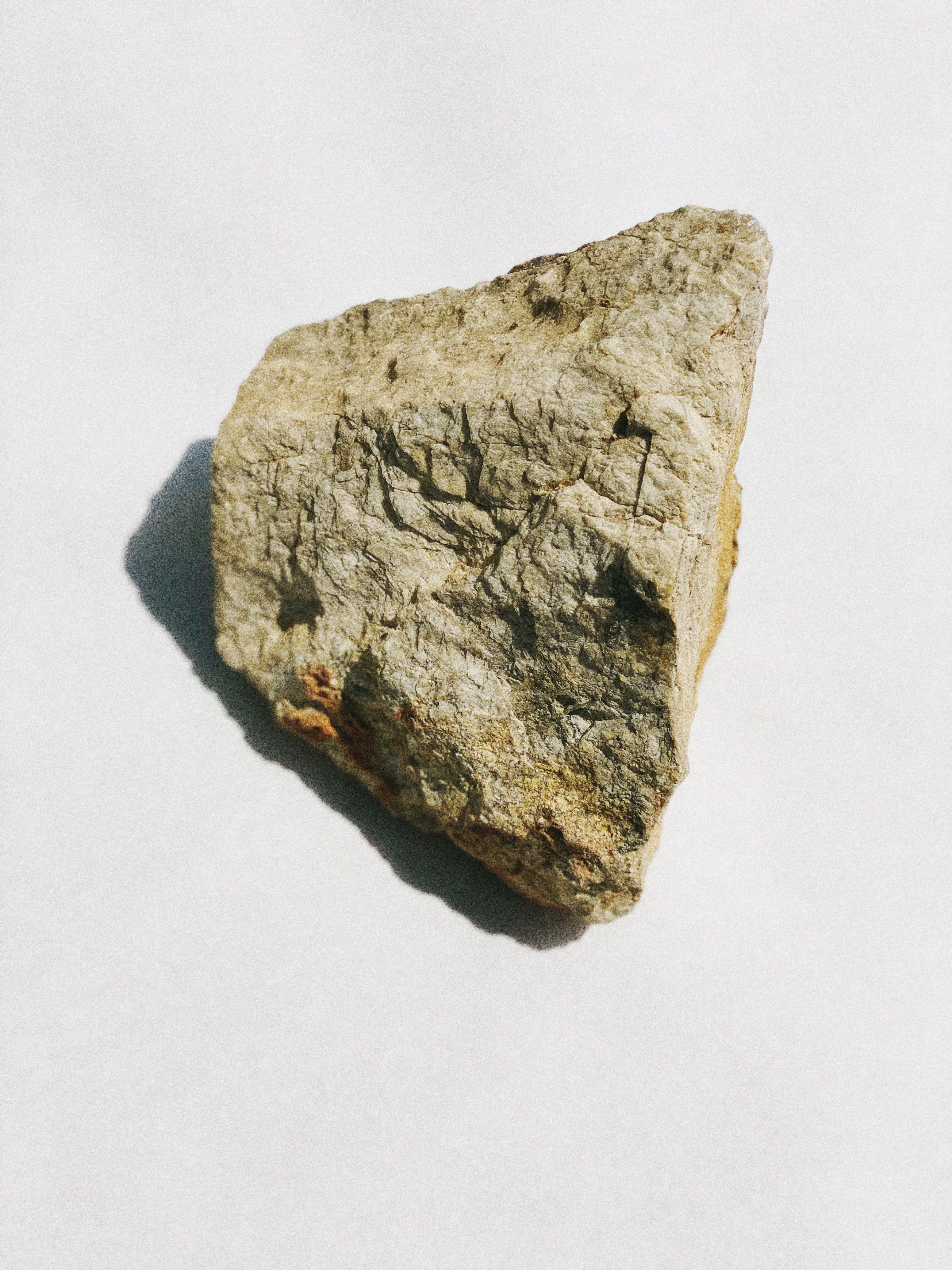
I collected in Hydra, Greece, almost exactly five years ago. It is heavy. A jagged trapezoid, its top leveled off — flat, like a platform rather than a peak. When I reach for it, something happens that I can only describe as a return. Not memory exactly. Something older. A pull back toward the place, the moment, the person I was becoming when I first held it.
I have been reaching for it a lot lately. Because I am doing something I have never done before: I am writing a book. It is, at its heart, a book about the creative process. About immersion and emergence. About what becomes possible when we learn to navigate our interior landscape — the subconscious terrain where vision, imagination, memory, and desire all move together. It is also a deconstruction of a methodology I have spent over a decade developing, refining, and living — a framework for accessing and translating what I have come to believe is the infinite creative potential that lives inside every one of us.
I am not going to explain all of that today. What I want to do, instead, is let you into the room where the book is being made.
What happened this morning
My writing practice begins with objects.
Not metaphorically. Literally. I gather things around me before I write — stones, images, artifacts from travels and encounters — and I let myself be pulled toward whichever one speaks first. This morning it was the stone from Hydra. I picked it up, I felt its weight, I examined its shape — that flat top, like the squared-off pyramids of Central and South America rather than the pinnacled structures of Egypt. A platform, not a point. And in that simple act of handling it, something opened.
What I discovered — or remembered I should say — is that this is exactly how I think. Through objects and through the body. Through sensation before meaning. I had to touch the stone before I could say anything true about it.
Here is a thing I am learning quickly about writing a book as a nonlinear thinker: I cannot simply sit down, outline, and execute. The material does not live in that register for me. It lives in the matter of my memory — in what rises in response to my touch, when I hold something long enough to feel where it takes me. So I am learning to write the way I think, which turns out to be closer to speaking than to writing.
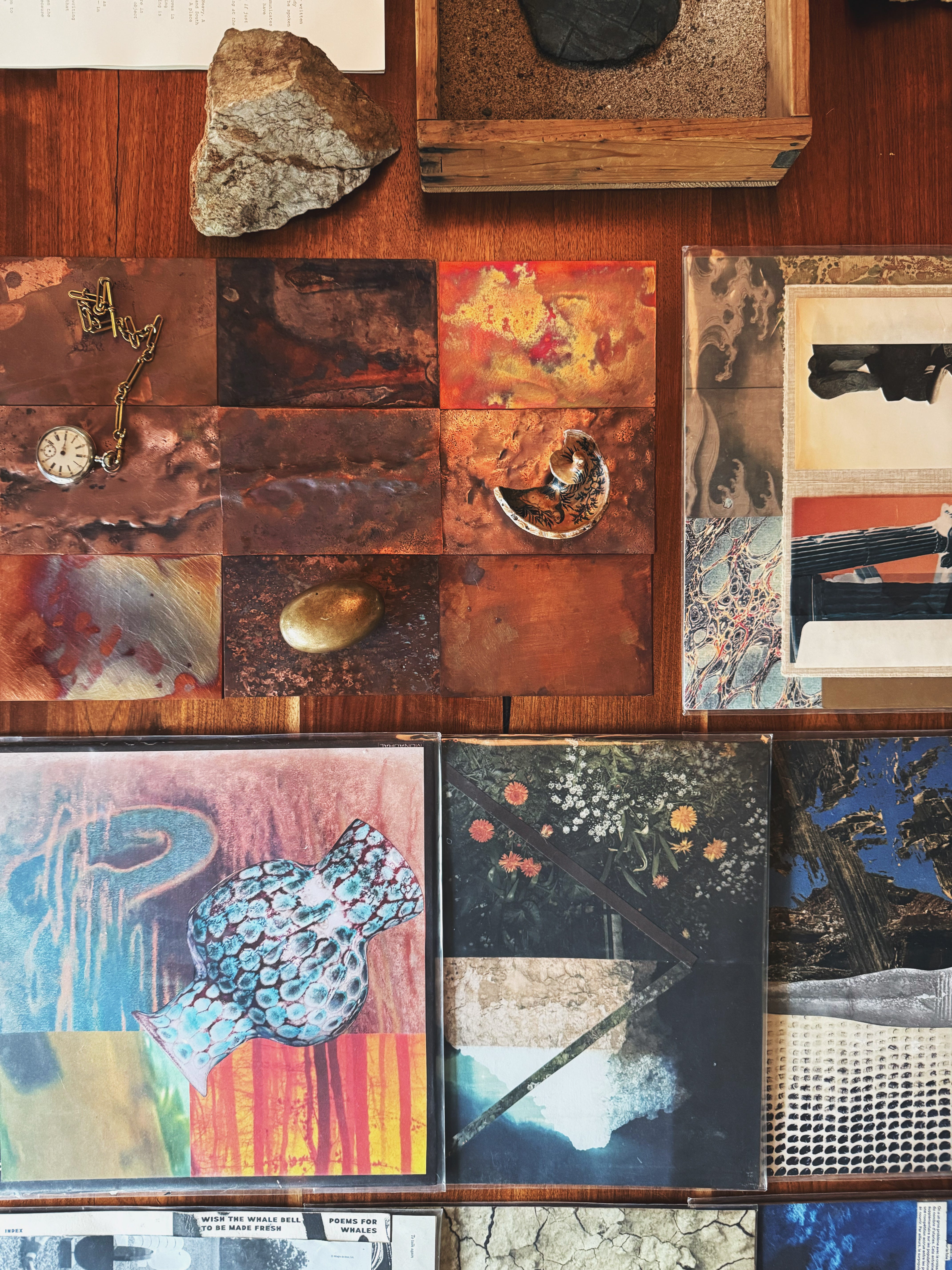
*Above image: organized chaos.
The difference between what is written and what is spoken
This morning I did something I have not done before in a writing practice. I wrote and I voice-noted. The same material, in two different forms, almost simultaneously.
What came out was completely different — and the difference taught me something I want to offer you here.
The written version arrived already knowing what it meant. It was architectural and structured. The stone was significant, and the writing knew that from the first sentence.
The spoken version did not know anything yet. It moved the way thought actually moves — haltingly, with pauses, doubling back, comparing the stone’s shape to pyramids I had seen in photographs as a child, arriving eventually at the word magnetism as if for the first time. As if I had not known, until the moment I said it aloud, that this was a story about being pulled. About connection that initiates from both sides. That word — magnetism — was not in the written version. It could not have been. I had to arrive at it through the act of speaking.
The discovery: the most alive version of my voice is always the spoken one. Speaking keeps me honest. I cannot skip ahead to the meaning. I have to move through the noticing first.
What I am teaching myself, in this book-writing practice, is how to write as if I have just spoken. To begin with the hand reaching for the stone, not with the significance already decided. To let the prose hesitate before it names. To trust that meaning will surface the way it did this morning — through genuine attention rather than prior arrangement.
What the book is actually about
Let me try to say it simply.
We are, each of us, a world containing infinite worlds.
What I mean is: the complexity of what lives inside a human body — the nervous system, the memory structure, the dreaming mind, the layered strata of everything we have felt and lost and forgotten and carried — is almost incomprehensible. We move through our days seeing only the surface of ourselves. We make decisions, create things, relate to others, largely from the shallow end of our own depth.
The book I am writing is an invitation to go deeper. To become, in a sense, an archaeologist of your own interior. To learn the language the inner world speaks — which is not the language of logic or productivity or optimization, but the language of symbol, image, sensation, and dream.
I have spent a decade leading Sēfari — immersive residencies for artists, creatives, and leaders — designed to help people descend into their own creative depth and return with something they could not have found on the surface. Twelve of those residencies have now been completed. The book is, in part, an attempt to distill and offer what those experiences have taught me — and what they have taught the extraordinary people who trusted me enough to enter that space.
It is also something more personal than that. It is the story of a child who wanted to be a treasure hunter. My earliest sense of vocation came through Indiana Jones — through the archetype of the one who enters dangerous, hidden, sacred spaces not to possess what is inside but to recover it. To bring something ancient back into the living world. That impulse has never left me, it has simply refined itself. The ruins I am most drawn to now are interior ones. And the treasure I am most interested in is the living image — the dream that has not yet been spoken, the memory waiting in the body like an artifact in the earth.
Why I am sharing this here
I have decided to let this Substack become part of the book’s making.
Not a behind-the-scenes account exactly. More like a companion practice. Some of what I discover in the writing room, I will bring here — not as finished ideas but as live ones, still warm from the finding. The stone this morning. The difference between written and spoken voice. The challenge of wrapping language around something as slippery and essential as the body’s own intelligence.
I believe that how we make things is as important as what we make. And I believe that sharing the process — honestly, imperfectly, in real time — is its own form of the methodology. Immerse to emerge. Enter the hidden space. Bring back what you find.
If this resonates, I would love to know what it stirs in you. What is the stone on your table? What object, place, or memory holds a world inside it that you have not yet found language for?
Jobi, I love this so much. I'm looking at the literal stones on my desk as I write this comment. The ones I keep here are from the Puget Sound beach I visit every weekend. I have some other rocks and shells in my art studio from places I've traveled. I feel most at home in coastal environments and the objects help me "revisit" those places when I paint.
I'm looking forward to following you here. It's funny, I just created a new exploratory place for myself as a blog category on my website called "Sketchbook". So often I feel pressure to only share finished paintings or ideas (or only share them once, in an "official" way), so giving myself the freedom of that space feels good. The feeling kind of reminds of me of what you may be using this space for in your book journey.
Love this peek into your process!